
















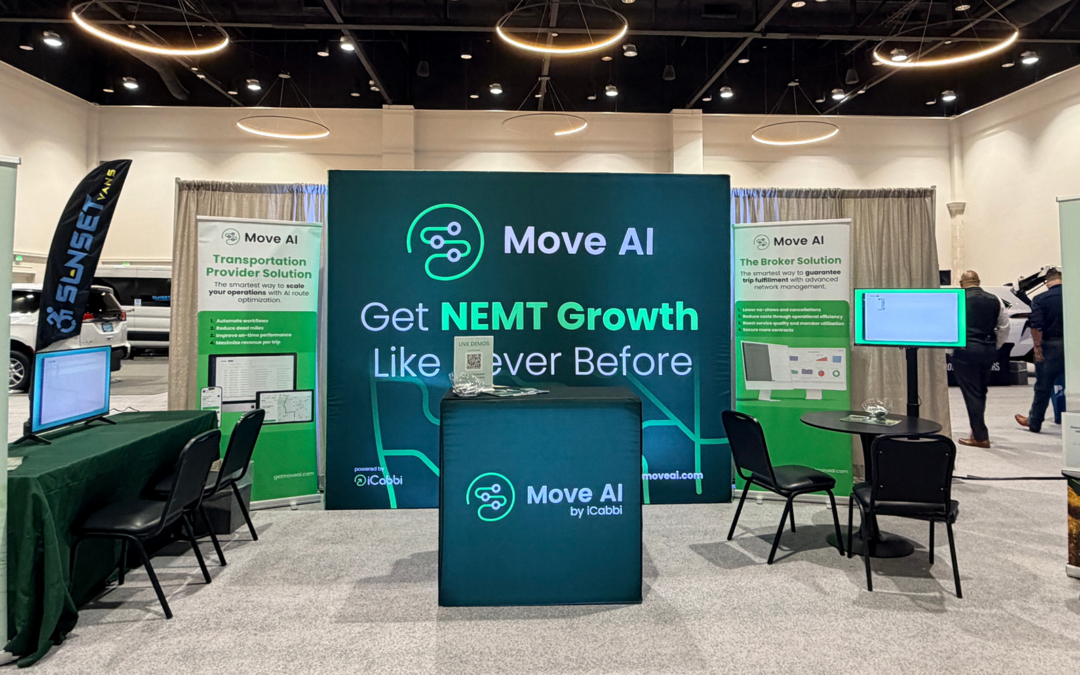
NEMTAC’s Transform gives a unique opportunity for transportation providers, brokers, technology companies, healthcare partners, regulators, and industry advocates to be in the same room challenging ideas and collaborating on solutions.
As exhibitors, it can be easy to spend an entire conference at the booth. This year, we made it a priority to get out and listen.
Over three days of sessions, conversations, roundtables, and our own discussion on future-proofing an NEMT business, we heard recurring challenges alongside examples of organizations actively working to address them.
Here’s what we heard.
1. Poor Communication Is Hindering Progress
The challenge:
NEMT involves many different stakeholders, each with its own terminology, processes, responsibilities, and priorities. Information can change hands several times before a trip ever reaches a transportation provider.
That creates opportunities for missing information, misunderstandings, delays, and additional work. Even something as fundamental as scheduling a trip can look different from one healthcare institution to another.
Where we’re seeing progress:
Efforts to standardize processes and advocate for greater consistency are growing across the industry. More consistent trip information, terminology, and expectations reduce unnecessary back-and-forth between organizations.
Roundtable discussions also reinforced the importance of bringing community health workers, patient navigators, and other frontline healthcare professionals into these conversations. They often understand firsthand what members are experiencing and can help identify what information should be consistently captured when transportation is arranged.
Continued dialogue among providers, brokers, healthcare organizations, community partners, and other stakeholders is equally important. Better communication depends on understanding how each part of the ecosystem operates, where information breaks down, and what each stakeholder needs to support the member effectively.
2. NEMT’s Value Is Bigger Than Access Alone
The challenge:
Access to transportation is essential, but access alone tells only part of the story.
As healthcare continues to place greater emphasis on value-based care, the opportunity is to better understand what additional value can be created through the trip itself and how transportation providers can contribute to the broader continuum of health.
Where we’re seeing progress:
Several conversations at Transform focused on recognizing transportation providers as more than a ride to an appointment. Because drivers interact directly with members, they can have insight into needs and health barriers that may not surface elsewhere in the care journey.
Kaizen Health shared an example of using the pickup, ride, and drop-off experience to identify health risk factors and better understand what a member may be experiencing outside the clinical setting.
Community partnerships were another recurring theme. Knowing which local organizations can support food security, housing, employment, and other social needs gives transportation providers another opportunity to connect members with resources beyond transportation.
For NEMT businesses, this creates an opportunity to demonstrate value differently. The question becomes not only, “Did we provide access to the appointment?” but also, “What did that access—and the insight gained along the way—contribute to the member’s broader health journey?”
3. Accountability Is The Expectation
The challenge:
Regulatory pressure to reduce fraud, waste, and abuse is not decreasing. Things like driver certifications, trip visibility and verification are the standard.
Healthcare organizations need greater confidence that the services they’re paying for were delivered and that the organizations providing them meet appropriate standards.
Where we’re seeing progress:
At Transform, we heard more about putting systems behind that accountability.
Kaizen Health developed the Kaizen Institute to train and credential drivers and strengthen trip verification, creating more consistent standards while supporting accurate billing.
Technology is strengthening accountability as well. Improved audit-ready documentation, trip verification stamps, and real-time trip visibility create stronger records of when, where, and how a trip was delivered.
The next challenge is making those expectations more consistent across the industry.
4. Provider Pay Need to Reflect the Reality of the Service
The challenge:
Fuel, insurance, maintenance, labor, wait times, no-shows, and other operating costs continue to squeeze transportation providers. Reimbursement rates need to better reflect both the cost of operating and the actual level of service required.
Where we’re seeing progress:
One of the most practical conversations at Transform centered on moving beyond broad trip categories and looking more closely at the level of service being delivered.
In Grove Transit’s presentation, they highlighted how using 2024’s BSR/NEMTAC’s six levels of transportation service could provide a foundation for developing more accurate and transparent rates based on the actual assistance required. For example, the rate for curb-to-curb service with no assistance should differ from curb-to-curb with assistance, since each requires different levels of time, training, staffing, and vehicle capability.
Other conversations focused on how technology can help providers reduce no-shows beyond member communication and reminders. Technology that identifies members or trip types with a higher likelihood of no-shows can help providers proactively prevent them and plan around them when they occur. For example, a platform could schedule a nearby backup trip so a driver isn’t left waiting or accumulating unnecessary miles if the original trip falls through.
More sustainable NEMT economics require looking at the real requirements of the service being delivered and using better planning to reduce avoidable losses.
5. Member-Centered Care Still Has to Lead the Way
The challenge:
As NEMT embraces more tech solutions, it’s important not to lose sight of what makes this industry different from many other technology-enabled industries: the people being transported often have needs that can’t be solved by efficiency alone.
There are also valid concerns about whether every member—particularly older adults—is ready or willing to use increasingly digital transportation experiences.
Where we’re seeing progress:
The shift toward value-based care is reinforcing the importance of keeping the member at the center of NEMT. Transportation providers are increasingly being recognized as part of the broader health continuum, with direct member interactions providing insights that can help identify unmet needs and connect members with supplemental support for food security, housing, employment, and other social drivers of health.
Technology also enables a more personalized approache to member care. Platforms with machine learning capabilities can identify communication preferences, recognize recurring trip patterns, and anticipate factors such as typical appointment duration—all of which help teams better plan around individual member needs.
In addition to accounting for individual member needs, technology adoption was also part of the conversation. During our speaking session, “Future-Proofing Your NEMT Business,” an audience member raised an important point: our perception of the “elderly” technology user is changing. The generations that have used smartphones, apps, online banking, and other digital tools for years are aging, and with that they bring different levels of comfort and expectations around technology.
Moving From Conversation to Progress
Transform reinforced something important: NEMT already understands many of its biggest challenges. The encouraging part is seeing more examples of organizations working on what comes next and how they do it collaboratively.
Communication is being addressed through more consistent standards and broader stakeholder input. Transportation providers are being viewed as key contributors to the broader health journey. Credentialing and technology are strengthening verification. Service-level standards are creating new ways to think about fairer provider economics. And technology and member care are increasingly being discussed as complementary rather than competing priorities.
There is still significant work ahead.
No single provider, broker, healthcare organization, technology company, regulator, or community organization can address these issues independently. Progress will depend on how well the different parts of NEMT work together.
The conversations may not be new. The opportunity now is to turn more of them into action.
How Move AI Can Help
The future of NEMT will depend on technology partners that can help organizations improve operations and scale while preserving the duty of care, relationships, and expertise that members depend on.
Move AI is built around that balance. Our route optimization and dispatch management platform helps transportation providers and brokers optimize complex operations while accounting for the real-world needs of each trip and member. From passenger-specific requirements and predictive planning to route optimization, multiloading, and dispatch automation, Move AI helps teams make better operational decisions at scale. These processes can be automated while giving team members the flexibility to step in and apply their judgment when needed. Book a demo to learn more.